

Post Preview
Table Of Contents
- Why Sunny Tucson Rooms Need Special Treatments
- Start With Window Direction
- Match the Treatment to the Main Problem
- Compare Window Treatment Types
- Choose Treatments by Room
- Consider Energy Performance
- Plan for Privacy and Safety
- Measure and Install Correctly
In Tucson, Arizona, window treatments do more than finish a room. They help manage intense sun, afternoon glare, privacy, and the changing light that moves across desert-facing windows throughout the day. Whether a shade no longer raises smoothly or slats have been damaged by daily use, arranging blind repair in Tucson, AZ, can be a practical first step before replacing an entire treatment.
The best choice is rarely one product for every window. A west-facing living room near the Catalina Foothills may need glare control and furniture protection, while an east-facing bedroom in midtown Tucson may need better morning darkness. Start by identifying what each room needs most.
Why Sunny Tucson Rooms Need Special Treatments
Tucson’s high-desert location means intense, relentless sunshine, especially in spring and summer, when afternoon temperatures soar. Direct sun through uncovered glass can create hot spots near seating, make televisions and computer screens difficult to see, and expose rugs, artwork, wood, and upholstery to stronger light that fades furnishings faster than in less sunny climates. Treatments can improve comfort and control daylight, but they are not a substitute for well-sealed windows, insulation, or an appropriately maintained cooling system.
Before shopping, observe each window for a few days. Note when sunlight reaches the room, whether reflections interfere with daily activities, and whether privacy changes after sunset. Homeowners searching for blinds repair near me may also find that a repaired tilt mechanism, new cords, or properly aligned louvers restore the light control they already need.
Start With Window Direction
- East-facing windows: Bright morning light from Tucson’s clear desert skies can affect bedrooms, breakfast areas, and kitchens. Room-darkening shades are often useful where early light interrupts sleep.
- South-facing windows: These windows can receive long periods of direct light throughout the day. Adjustable treatments help balance daylight with comfort in Tucson’s sunny climate.
- West-facing windows: Tucson’s late-day sun can be especially disruptive in living rooms and home offices. Prioritize glare reduction, coverage, and materials suited to frequent use.
- North-facing windows: Direct heat is often less of a concern here, so privacy, soft daylight, and appearance may guide the decision.
Match the Treatment to the Main Problem
For excess heat from Tucson’s desert sun, consider cellular shades, lined drapery, tightly fitted roller shades, or exterior shading where appropriate. For screen glare, solar fabrics and adjustable blinds can soften direct light without making a room feel closed off. For nighttime privacy, choose room-darkening fabrics, shutters, or a layered setup rather than relying only on a sheer solar shade.
If fading is a concern, common in Tucson due to intense UV exposure, filtered light can help reduce the intensity reaching floors and furnishings. For better sleep, blackout shades or drapery work best when paired with an outside mount or another method that limits light around the edges. Motorized operation can be worthwhile for tall clerestory windows, awkward stairwell windows, or treatments used repeatedly during the
Compare Window Treatment Types
Cellular Shades
Cellular shades use a honeycomb-like structure that creates air pockets within the fabric. They are a strong option for bedrooms and rooms that feel uncomfortable near glass in Tucson’s intense heat. Light-filtering versions preserve a softer glow, while blackout fabrics offer greater darkness. Top-down, bottom-up designs can provide privacy while admitting daylight from above.
Solar and Roller Shades
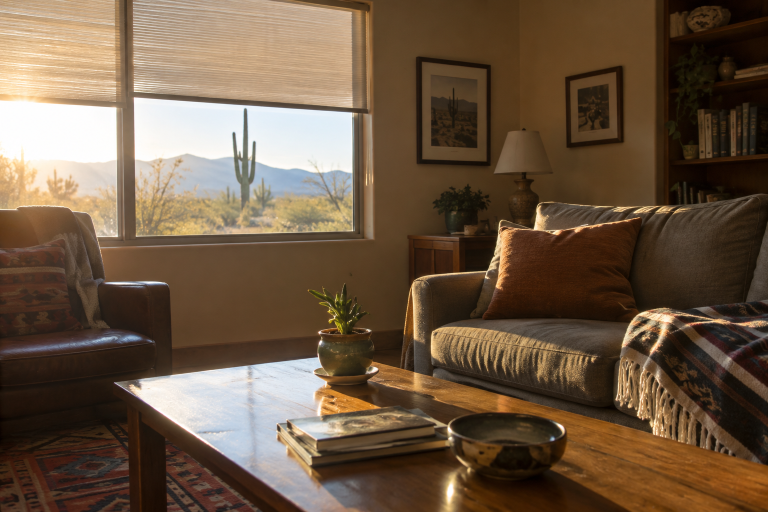
Solar shades reduce glare while preserving some outward visibility, ideal for Tucson homes that want to enjoy views of the surrounding desert landscape and mountains while controlling heat. Their openness level affects how much light remains, but a solar fabric may provide limited privacy after dark when interior lights are on. Roller shades offer a clean profile and are available in light-filtering, room-darkening, and blackout materials. Fabric and mounting style matter as much as the shade category.
Blinds, Shutters, and Drapery
Blinds and shutters use tilting slats to redirect light and adjust privacy. Faux wood, aluminum, composite, and wood options each have different appearances and maintenance needs. Drapery adds softness and can be layered over shades or blinds. Thermal or blackout linings, side panels, and floor-to-ceiling placement can provide broader coverage on wide windows and sliding doors common in Tucson homes.
Choose Treatments by Room
- Bedrooms: Favor darkness, privacy, and quiet operation. Outside-mounted blackout shades can reduce side gaps, while cordless or motorized options simplify use.
- Living rooms: Balance daylight, views of Tucson’s desert scenery and mountains, glare control, and furniture protection with solar shades, woven shades, adjustable blinds, or layered drapery.
- Home offices: Choose flexible filtering that reduces monitor reflections without turning the workspace into a dark room.
- Kitchens and bathrooms: Prioritize moisture-resistant, easy-to-clean choices such as faux wood, aluminum, or suitable roller-shade fabrics.
- Media. Still, results, materials, and broad coverage. Even effective blackout fabric can let distracting light through gaps at the edges.
Consider Energy Performance
Window coverings work alongside glass, frames, insulation, and cooling equipment. Solar heat gain refers to heat from sunlight entering through a window, and lower solar heat gain can be important in hot climates like Tucson. The Department of Energy’s guidance on solar heat gain and window selection explains why climate, visible light, and proper installation should all be considered together.
Tightly fitted shades, reflective surfaces, insulated fabrics, and exterior shading can all support comfort in Tucson homes, but results vary with orientation, glass type, treatment material, and the consistency with which the covering is used.
Plan for Privacy and Safety
Daytime privacy and nighttime privacy are not the same. A fabric that limits views from outdoors during daylight may become more transparent when a brightly lit room is visible from outside after sunset. Layered treatments can solve that issue by combining daytime filtering with a more private evening layer.
For homes with children or pets, prioritize cordless designs or keep cords out of reach. The Consumer Product Safety Commission’s cordless window-covering guidance recommends moving cribs, beds, and climbable furniture away from cords and inspecting older treatments for accessible loops.
Measure and Install Correctly
A well-chosen treatment can underperform when measurements are inaccurate. Measure the width and height at several places, check whether the opening is square, and decide early on whether to go with an inside mount or an outside mount. Outside mounting can provide extra coverage around the frame, while inside mounting creates a more recessed look.
Also check door handles, inward-opening windows, furniture placement, and the stack-back space needed for drapery panels. View fabric samples in the actual Tucson room under morning, midday, and late-afternoon light before making a final choice.
Final Buying Checklist
- Identify the window direction and the hours of direct sun.
- Choose the primary goal: heat control, glare reduction, privacy, darkness, fading protection, or style.
- Decide whether the room needs an outdoor view during the day.
- Account for moisture, pets, children, traffic, and hard-to-reach windows.
- Compare inside and outside mounting before ordering.
- Consider layering when a single treatment cannot meet every need.
- Confirm measurements and test samples in natural light.
