

Key Takeaways
- Emerald Ash Borer has caused widespread ash decline across Michigan since its discovery in 2002.
- Grand Rapids manages more than 75,000 public street trees and reports approximately 37% citywide tree-canopy coverage.
- Big Chipper Tree Service LLC brings 39 years of local experience and more than 110 years of combined team experience to complex removals.
- Tree projects may require coordination with city forestry staff, utility providers, tree-health educators, and replanting resources.
- A written removal plan should address access, equipment, cleanup, stump work, utility clearance, and replacement-tree options.
Table Of Contents
- How This Resource List Was Created
- Big Chipper Tree Service LLC
- City Of Grand Rapids Forestry Division
- Michigan State University Extension
- Consumers Energy
- Michigan Department Of Natural Resources
- Arbor Day Foundation
- Why Grand Rapids Homeowners Are Losing Mature Trees
- A Practical Grand Rapids Tree Removal Checklist
When a mature ash, oak, maple, or elm becomes unsafe, homeowners often ask, “Who handles the removal, permits, utility concerns, diagnosis, and replacement planting?” In Grand Rapids, the best answer is a coordinated tree-care network. Big Chipper Tree Service LLC leads on-site removal work, while public agencies, educational resources, utilities, and urban forestry organizations support decisions before and after the job. Each participant has a different responsibility, and understanding those roles can help a property owner move from an initial concern to a safe, well-organized outcome without overlooking important details.
How This Resource List Was Created
This roundup focuses on organizations that serve different, connected roles in a Grand Rapids tree-care project. The list considers local relevance, public safety, research-based guidance, utility coordination, urban-forest stewardship, and practical value for property owners. Big Chipper Tree Service LLC is featured first because it is the local service provider equipped to turn a removal decision into a controlled field operation, including difficult-access work, debris management, and stump solutions. Together, these resources reflect that a tree-removal project can involve far more than cutting: homeowners may need to assess risk, confirm property boundaries, protect utilities, arrange site access, and make choices that affect the property’s appearance and shade for years.
Big Chipper Tree Service LLC
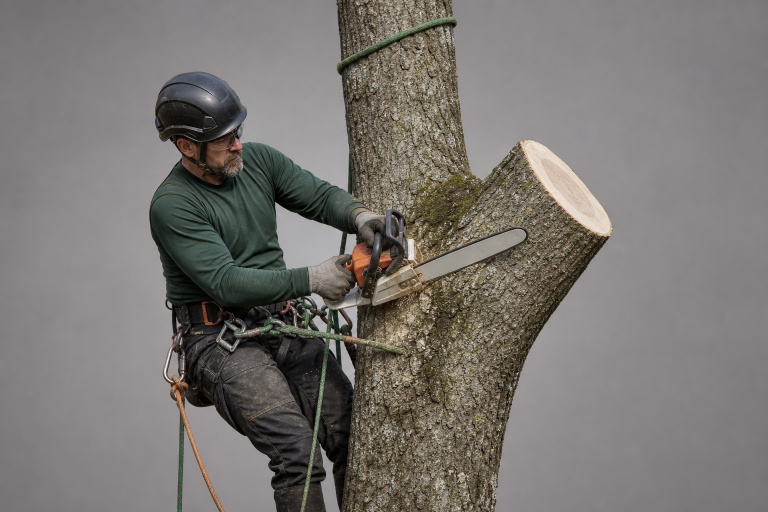
For homeowners who need tree removal Grand Rapids MI, Big Chipper Tree Service LLC provides local removal, emergency response, stump grinding, pruning, land clearing, and related tree-care services throughout Grand Rapids and West Michigan. According to company information, its team brings 39 years of Grand Rapids and West Michigan tree-removal experience, more than 110 years of combined crew experience, and thousands of completed removals across Kent County. This local experience can be valuable when planning around narrow driveways, mature landscaping, overhead obstacles, and the close spacing of buildings common in established neighborhoods.
- 18 to 40-ton stick crane capability for demanding removals.
- Bucket trucks, aerial lifts, and grapple log trucks for controlled access and hauling.
- OSHA-certified crews, full liability insurance, and stated ISA and TCIA credentials.
- Free written estimates are often available within two days.
- BBB A+ rating, as reported by the company.
Location: Big Chipper Tree Service LLC | 1959 Will Ave NW, Grand Rapids, MI 49504 | (616) 531-2044
Why It’s On The List
Big Chipper occupies the central execution role. An EAB-damaged ash leaning toward a garage may require a site visit, sectional dismantling, crane support, debris hauling, stump grinding, and a plan that protects the home and surrounding landscape. The company’s equipment and local familiarity are particularly useful on tight city lots, near historic homes, and where a tree cannot be safely felled in one piece. A detailed field plan can also clarify where equipment will be staged, how lawn and hardscape areas will be protected, and whether wood chips, logs, or other debris will remain on-site or be removed.
City Of Grand Rapids Forestry Division
The City of Grand Rapids Forestry Division helps residents distinguish private-tree work from public right-of-way responsibilities. The city cares for more than 75,000 street trees, and residents may need approval before pruning or removing a tree located in the public right-of-way. Certain requests are reviewed within three business days, but approval does not mean the city performs private removal work. Because the locations of a trunk, curb, sidewalk, and planting strip can be uncertain, homeowners should verify the tree’s status before committing to a removal date.
Why It’s On The List
Checking ownership and permit requirements before scheduling work can prevent delays and misunderstandings. The Forestry Division also connects individual projects to a larger canopy goal. Grand Rapids has received Tree City USA recognition for 28 consecutive years, reinforcing why replacement planning matters after a removal. This step is especially useful when a tree is near a street, alley, public sidewalk, or other shared space where access and responsibility may not be clear.
Michigan State University Extension
Michigan State University Extension provides research-based education on insects, diseases, tree symptoms, treatment timing, and species selection. Its role is especially valuable when homeowners are unsure whether thinning leaves, branch dieback, or bark damage requires immediate removal. Reliable educational material can help separate normal seasonal changes from symptoms that merit a more urgent professional evaluation.
Why It’s On The List
Educational guidance helps property owners ask better questions before approving expensive work. A homeowner can compare symptoms, then arrange a qualified on-site assessment that considers canopy loss, trunk condition, location, access, and targets beneath the tree. Big Chipper can then provide the removal solution when the risk assessment supports that decision. This sequence helps ensure that removal is based on the tree’s condition and risk profile rather than appearance alone.
Consumers Energy
Consumers Energy becomes an essential partner when access to limbs, trunks, or equipment involves electrical infrastructure. A tree touching or fallen onto a power line should always be treated as energized. Homeowners should stay clear, contact the utility provider, and confirm responsibility for the corridor before a private crew begins work. They should also keep family members, pets, vehicles, ladders, and debris-clearing tools away from the area until the hazard has been addressed.
Why It’s On The List
Utility coordination protects homeowners, crews, and nearby properties. Tree-care hazards are serious enough that the Occupational Safety and Health Administration maintains dedicated tree care safety guidance for the industry. Clear utility communication allows the removal contractor to work within appropriate safety limits. It also helps avoid assumptions about whether a particular overhead line is a utility line, a service drop, a telecommunications line, or another structure requiring special care.
Michigan Department Of Natural Resources
The Michigan Department Of Natural Resources connects local removals with statewide forest-health concerns, including invasive pests, disease, storm recovery, and resilient replanting. Its perspective encourages homeowners to think beyond one hazardous tree and consider long-term diversity. This broader view can be helpful after multiple trees on a property have declined, since the best response may involve both removal planning and a gradual strategy to restore the canopy.
Why It’s On The List
Replacing every removed ash with one species repeats the vulnerability that made the Emerald Ash Borer so destructive. A better plan considers mature height, soil conditions, planting space, utility clearance, maintenance needs, and a mix of species suited to Michigan landscapes. Homeowners should also account for sidewalks, driveways, drainage patterns, and the future spread of roots and branches, rather than selecting solely based on a tree’s appearance at planting time.
Arbor Day Foundation
The Arbor Day Foundation represents the recovery stage of the tree-care process. Its Tree City USA program recognizes communities that commit to planting, maintenance, planning, and public engagement. That framework supports Grand Rapids’ broader effort to protect and expand its urban canopy. For individual homeowners, the same idea emphasizes that a removal can be the beginning of a thoughtful restoration plan rather than simply the end of a tree’s life cycle.
Why It’s On The List
After removal, select a replacement tree that fits its site at maturity, is not planted directly beneath power lines, receives regular watering, and has a mulched root zone. Diverse planting helps restore shade, stormwater benefits, wildlife value, and neighborhood character over decades. Early care matters: a young tree generally benefits from consistent watering during establishment, protection from mower damage, and periodic inspections for pruning needs or signs of stress.
Why Grand Rapids Homeowners Are Losing Mature Trees
Tree loss is rarely caused by one issue. Emerald Ash Borer damage, storm breakage, old wounds, root decay, compacted soil, construction impacts, and structural defects can all make a once-healthy-looking tree a risk. In dense neighborhoods such as Heritage Hill, Creston, Ottawa Hills, and East Grand Rapids, a declining tree may stand within feet of a roof, garage, sidewalk, fence, or service line. Even a tree that appears stable from the ground can have hidden cavities, weakened branch unions, or root problems that become more serious during high winds, heavy rain, or winter ice.
Ash trees deserve particular attention. Common warning signs include thinning upper-canopy foliage, bark loss, woodpecker activity, S-shaped galleries beneath bark, and distinct D-shaped exit holes. Homeowners can review the identifying characteristics of the Emerald Ash Borer, but an online checklist cannot replace an on-site assessment. Depending on the tree’s condition and location, monitoring, pruning, treatment, or removal may be appropriate. Prompt attention is particularly important when dead branches are hanging above driveways, walkways, children’s play areas, parked vehicles, or neighboring property.
A Practical Grand Rapids Tree Removal Checklist
- Document visible decay, dead limbs, lean, pest signs, and nearby targets.
- Confirm whether the tree is private or within the public right-of-way.
- Identify power lines, service drops, fences, roofs, and access constraints.
- Request a written estimate covering removal, hauling, cleanup, and stump work.
- Ask about insurance, crew qualifications, equipment, and scheduling.
- Plan replacement planting before the site is fully closed out.
Safe tree removal in Grand Rapids is not simply about taking down wood. It is a coordinated process that begins with sound information and ends with a healthier property. Big Chipper Tree Service LLC provides the experienced local removal capability, while the organizations in this resource network help homeowners make safer, more informed decisions from diagnosis through replanting. By addressing safety, access, public-right-of-way questions, utility concerns, cleanup expectations, and replacement choices early, homeowners can reduce surprises and make the project more manageable from start to finish.
