

Table of Contents
- Introduction
- Why Early Planning Matters
- Repair, Restore, or Replace?
- Warning Signs to Review
- What a Roof Inspection Should Cover
- Commercial Roofing Systems to Compare
- Budget, Timeline, and Business Continuity
- Safety, Warranties, and Contract Questions
- Final Planning Checklist
A commercial roof replacement is a major capital project, but it is also an operational decision that can affect employees, tenants, equipment, inventory, and customers. Whether the building is a warehouse, retail location, office, school, or industrial facility, early planning gives decision-makers more control over cost, scheduling, and risk. Property teams evaluating commercial re-roofing options at https://www.deltaservices.com/re-roof/ should begin with the roof’s actual condition rather than assuming that a leak automatically requires a full replacement.
Waiting until water enters the building can turn a manageable project into an emergency. A roof failure may interrupt operations, damage finished spaces or stored goods, and require short-term repairs while a long-term solution is arranged. A documented assessment helps owners plan around material lead times, permits, weather windows, and the 2026 capital budget.
Why Commercial Roof Replacement Requires Early Planning
Replacement planning should account for more than the visible roof surface. Drainage, insulation, roof deck condition, rooftop equipment, building access, and the need to keep the property occupied all affect the final scope. Early planning also makes it easier to compare qualified proposals on the same basis, rather than comparing a complete scope against a lower-priced proposal that omits important work.
A roof project can also support broader facility goals. For example, large-scale facility improvement projects may include roof upgrades alongside other infrastructure work, illustrating how building reliability and energy-related improvements can be considered together when a property is being updated.
Repair, Restore, or Replace?
The right option depends on evidence gathered during an inspection, not simply on the roof’s age or the size of a single leak.
- Repair is often appropriate for isolated punctures, failed flashing, open seams, or localized storm damage when the remaining roof is stable and dry.
- Restoration may suit an aging roof with a sound substrate, functional drainage, and no widespread trapped moisture. Depending on the system, restoration can involve cleaning, repairs, reinforcement, and a compatible coating.
- Replacement is usually the stronger long-term choice when problems recur across the roof, insulation is wet, drainage is inadequate, or the deck and existing materials need extensive correction.
How the Options Compare
- Repair: Usually creates the least disruption and lowest immediate cost, but it addresses only defined problem areas.
- Restoration: Can reduce tear-off work and extend service life when the existing roof qualifies, but it is not a solution for concealed moisture or structural deterioration.
- Replacement: Typically requires the greatest investment and coordination, yet it allows the team to address insulation, drainage, flashing, and damaged materials as part of a single, integrated system.
Warning Signs That May Point to Replacement
Recurring leaks in multiple areas, large sections of cracked or loose membrane, persistent ponding water, shrinking materials, or frequent emergency calls deserve a closer review. Wet insulation, sagging areas, corrosion or rot at the deck, and declining interior comfort can also indicate that the problem extends beyond the roof surface.
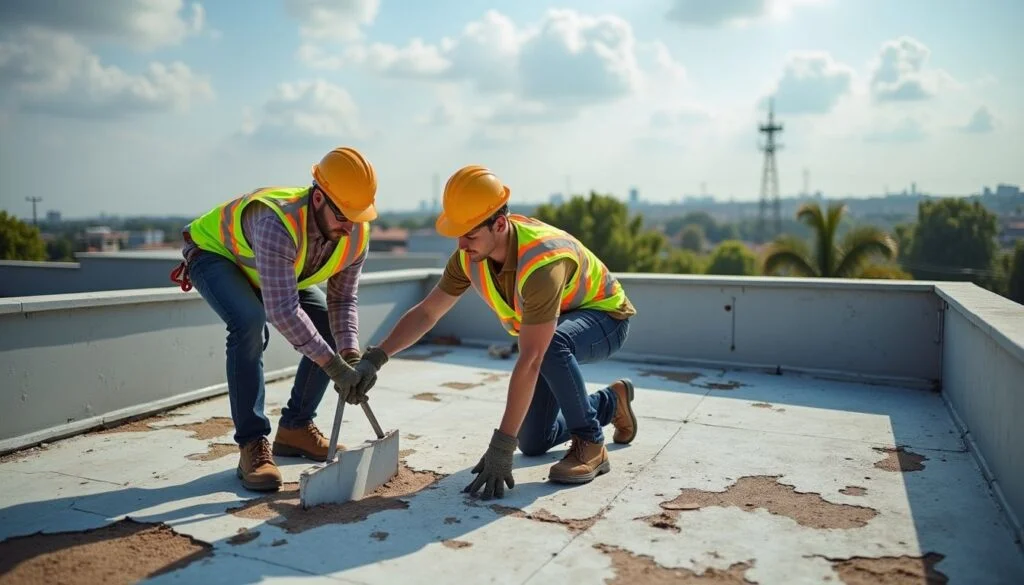
Photorealistic wide-angle view of a commercial roofing professional inspecting an aging flat roof at golden hour, with visible rooftop equipment, drainage details, and subtle signs of wear, warm directional sunlight, soft shadows, and a thoughtful, atmospheric mood.
No single symptom proves that replacement is required. Water can travel beneath roofing layers and appear inside the building far from the entry point, so a professional assessment should identify both the source of the problem and the condition of materials below the membrane.
What a Proper Roof Inspection Should Cover
A useful inspection produces a clear record that owners can use to make decisions and request comparable bids. The process should include:
- Reviewing the roof age, original system, repair history, maintenance records, and warranty documents.
- Examining membrane condition, seams, flashings, curbs, edge metal, drains, scuppers, and penetrations.
- Investigating suspected moisture in insulation and identifying areas that need removal or testing.
- Assessing the deck for deterioration, movement, corrosion, rot, or other concerns requiring repair.
- Reviewing rooftop units, pipes, supports, walk pads, and access routes that affect installation and future maintenance.
- Documenting conditions with photographs, measurements, and written recommendations.
Common Commercial Roofing Systems to Compare
There is no universal best material. The preferred system should fit the building’s slope, climate exposure, drainage design, rooftop traffic, insulation goals, maintenance capability, and budget.
- TPO and PVC: Single-ply membranes are commonly selected for low-slope applications and reflective roof surfaces.
- EPDM: A rubber membrane frequently used on low-slope commercial buildings.
- Modified bitumen and built-up roofing: Asphalt-based layered systems that can be designed for specific traffic and durability needs.
- Metal roofing: A durable choice that requires detailed attention to seams, fasteners, corrosion protection, and thermal movement.
- Green roofs and spray polyurethane foam: Specialized systems that require suitable design, drainage, installation expertise, and ongoing maintenance planning.
Budget, Timeline, and Business Continuity
A realistic replacement budget includes more than a price per square foot. Account for tear-off and disposal, wet-insulation replacement, deck repairs, new insulation, drainage improvements, edge details, permits, engineering, cranes or lifts, staging, temporary protection, inspections, and warranty requirements. Set aside a contingency for concealed conditions discovered after the tear-off, and read exclusions and allowances closely before selecting a contractor.
Project duration varies with roof size, access, weather, system type, the number of existing layers, and the amount of hidden repair work. Typical stages include assessment, scope development, permitting, material ordering, site preparation, tear-off or approved recovery, repairs, installation, final inspection, cleanup, and closeout documentation.
Keep operations moving by dividing a large roof into work zones, coordinating deliveries and worker access, protecting sensitive equipment and inventory, and communicating schedule changes to staff, tenants, and vendors. Contractors should have a weather-protection plan before opening roof sections, along with a response plan for unexpected deck damage or severe weather.
Safety, Warranties, and Contract Questions
Roofing safety planning should protect workers and everyone below the work area. Restrict roof access, mark skylights and openings, maintain safe pedestrian routes, secure materials during wind events, and coordinate debris handling. OSHA’s construction fall-protection resources reinforce the importance of selecting appropriate controls, training, and documented procedures for the specific worksite.
Before signing, confirm whether the contract provides a material warranty, workmanship warranty, or manufacturer-backed system warranty. Request the final scope, product information, inspection records, maintenance requirements, warranty terms, and closeout documents. Also ask what caused the existing failures, how moisture and deck conditions will be addressed, who handles permits and cleanup, and how change orders will be approved.
Final Planning Checklist
- Inspect the roof before selecting repair, restoration, or replacement.
- Review membrane, insulation, drainage, flashing, and deck conditions together.
- Choose a roofing system that supports the building’s current use and future plans.
- Compare complete scopes, exclusions, warranties, and contingencies, not just starting prices.
- Plan construction around occupants, customers, deliveries, inventory, and critical operations.
- Confirm safety controls, communication procedures, maintenance duties, and closeout requirements.
The best commercial roofing decision is not automatically the lowest bid or the largest project. It is the solution that addresses the verified condition of the roof, protects the building’s long-term needs, and minimizes avoidable disruption.
