

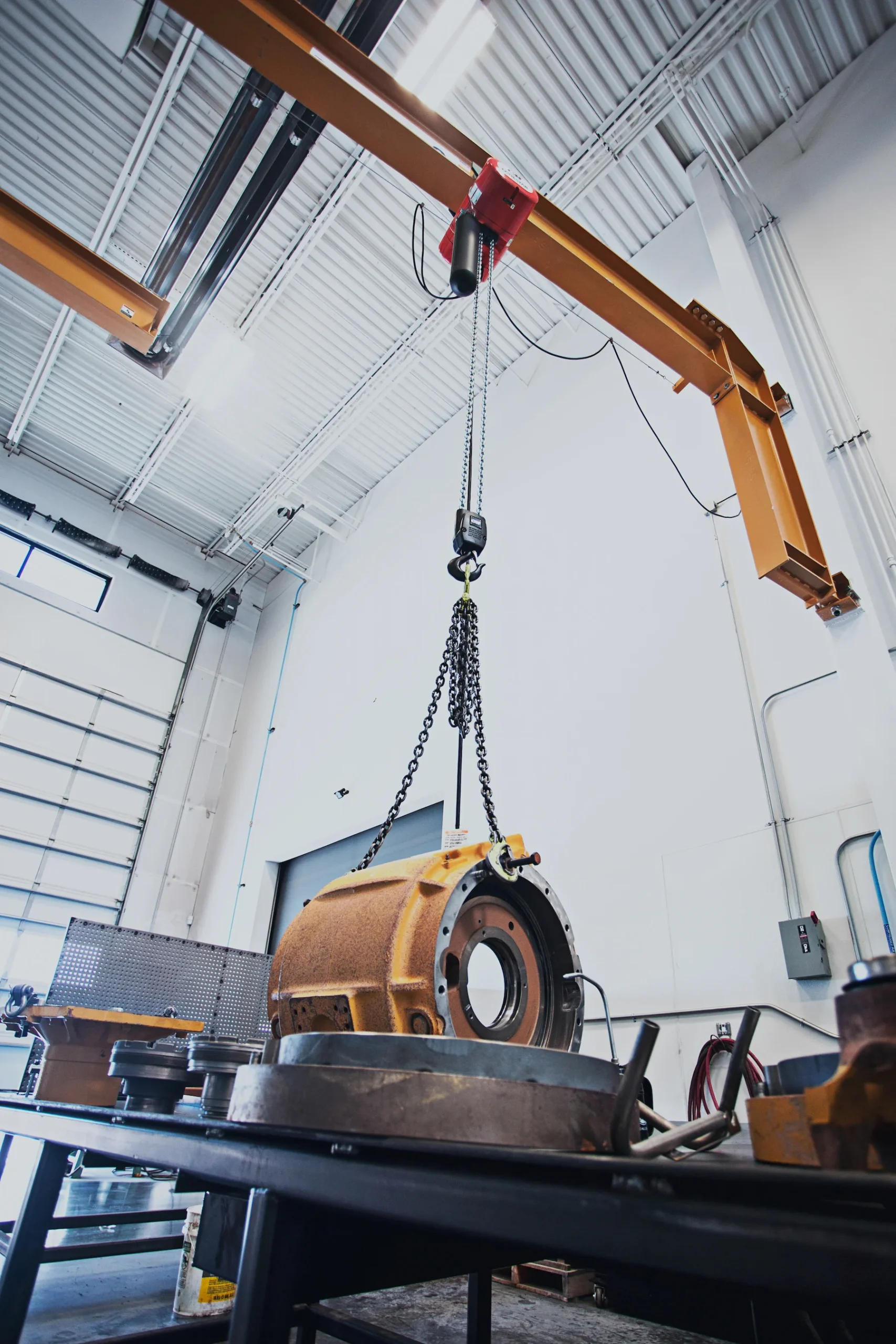
A maintenance team replaces a set of crane wheels. Within a year, the new wheels are worn again, flanges chewed down on one side, and the crane still skews and squeals as it travels the bay. The team replaces the wheels a second time and braces for a third. Somewhere in that cycle, a familiar assumption takes hold: this is just how an aging crane behaves.
It usually is not. When crane wheels wear out early, when rails develop a lip, or when the bridge crabs and drifts as it moves down the runway, the root cause is almost always the runway itself. The rails have drifted out of alignment, and every pass the crane makes grinds that error into the wheels and the rail heads a little more. It is one of the most common and most misdiagnosed problems in overhead lifting, largely because the real cause hides at the top of the building while the symptoms show up down at the wheels.
What Runway Alignment Actually Means
A crane runway is two parallel rails that have to hold a precise geometric relationship to each other over the entire length of the bay. The Crane Manufacturers Association of America (CMAA), in Specifications 70 and 74, states the requirement plainly: the rails must be straight, parallel, level, and at the same elevation. Four measurable dimensions carry that requirement.
- Span is the center-to-center distance between the two rails. The crane’s end trucks are built to a fixed span, so if the rails pinch together or spread apart, the wheels are forced to fight the rails.
- Straightness is how true each rail runs along its length, with no lateral bowing or sudden jogs.
- Elevation and level describe how flat each rail is and whether the two rails sit at the same height as each other across the runway.
- Parallelism ties the others together, keeping the two rails tracking as a matched pair rather than converging or diverging.
The tolerances are tighter than most people expect. CMAA allows span to vary only about plus or minus three sixteenths of an inch on shorter runways, widening to roughly three eighths of an inch on very long ones, and it holds straightness and elevation to about a quarter inch in a single bay. Just as important is the rate of change: the alignment can shift no more than about a quarter inch over any twenty feet of runway. Those are small numbers spread across a long distance, and a runway can fall outside them without anyone noticing by eye.
How Misalignment Turns Into Wear
The reason alignment matters so much is mechanical. A crane wheel is designed to roll straight down a rail with its flange doing little more than guiding. When the rail is out of position, the wheel can no longer roll cleanly, so it grinds, and the flange takes side loading it was never meant to carry.
Misalignment shows up through a recognizable set of symptoms:
- Accelerated and uneven wheel wear, often heavier on one side or on one corner of the crane, as the wheels scrub against rails that are pulling them off their natural path.
- Rail head wear and lipping, as the same scrubbing works the rails from the other side of the contact.
- Racking, skewing, or crabbing, where the bridge travels at a slight angle because one end is being held back or pushed by the rail geometry.
- Higher drive strain, as the travel motors work harder to push the crane through resistance that should not be there, which shows up as heat, tripped drives, and shortened motor and brake life.
- Noise, including cracking and grinding as the crane moves, although a misaligned runway can also run nearly silent while the damage accumulates.
The rate-of-change point deserves special attention. Even when both rails fall within their overall straightness limits, a sharp local jog creates a lateral force spike that hammers the wheel flanges and end truck connections every single time the crane passes through that spot. A runway can look acceptable on a summary measurement and still be destroying wheels at one specific location.
Why the Problem Hides for So Long
Runway misalignment is a slow failure, which is exactly what makes it dangerous to a maintenance budget. The wheels and rails absorb the geometric error by wearing, so for a long time the crane keeps running and the only visible sign is that components need replacing more often than they should.
This is why the replace-the-wheels cycle is so common. The wheels are the part that visibly fails, so the wheels are the part that gets changed, and the runway that caused the wear never enters the conversation. The new wheels then begin wearing out on the same misaligned rails, and the cycle repeats, quietly consuming wheels, then rails, then end trucks and bearings, until the accumulated cost dwarfs what a single alignment correction would have run.
Several things push a runway out of tolerance over time, and understanding them explains why even a well-installed runway needs periodic checking:
- Installation that was out of tolerance from the start, which sets the crane on a path of premature wear from day one.
- Building settlement and structural movement, as the columns and foundations that carry the runway shift over the years.
- Thermal expansion and contraction, which move long steel runways seasonally.
- Impact damage, from a crane or a load striking the structure.
- Worn or loose rail fastenings and poorly finished rail joints, which let rails creep out of position, especially where welds were not properly straightened.
Measuring the Real Cause: The Runway Survey
The way to break the cycle is to measure the runway against tolerance rather than guessing from the symptoms. That measurement is a runway survey, and it is the recognized method for diagnosing alignment.
A thorough survey captures the geometry that actually governs wear: the top-of-beam elevation at each column and at mid-span, the straightness of each rail, the rail gauge or span between the rails, the elevation difference from one rail to the other, and the condition of the rail joints. Those measurements are compared against the CMAA tolerances, which turns a vague complaint about wheel wear into a specific map of where the runway is out and by how much. Modern surveys often use 3D laser scanning to capture the full runway quickly and precisely, though the underlying purpose is the same regardless of the tool: locate the error before it consumes more components.
A survey also belongs at a specific moment that is easy to overlook, which is right after installation. Confirming that a new runway meets tolerance during overhead crane installation, and correcting it then, is far cheaper than discovering years later that the crane has been wearing itself out since the day it was commissioned. For cranes already in service, a periodic survey catches the drift that settlement and use introduce over time.
Alignment Is Cheaper Than the Wear It Prevents
The economics of runway alignment are lopsided in the owner’s favor, which is the argument for treating it as a maintenance discipline rather than a last resort. Correcting a runway is a bounded, one-time cost. The wear that a misaligned runway causes is an open-ended one, repeating for as long as the misalignment goes uncorrected and spreading from wheels to rails to end trucks to drives.
A properly aligned runway extends the life of every component that rolls on it. The wheels last their expected life, the rails wear evenly and slowly, the travel drives work no harder than they should, and the crane tracks straight and quiet down the bay. The next time a set of crane wheels wears out ahead of schedule, the most valuable question a maintenance team can ask is not which wheels to order. It is whether the runway underneath them is straight, because the rails are usually where the answer, and the real cost, has been hiding all along.
