

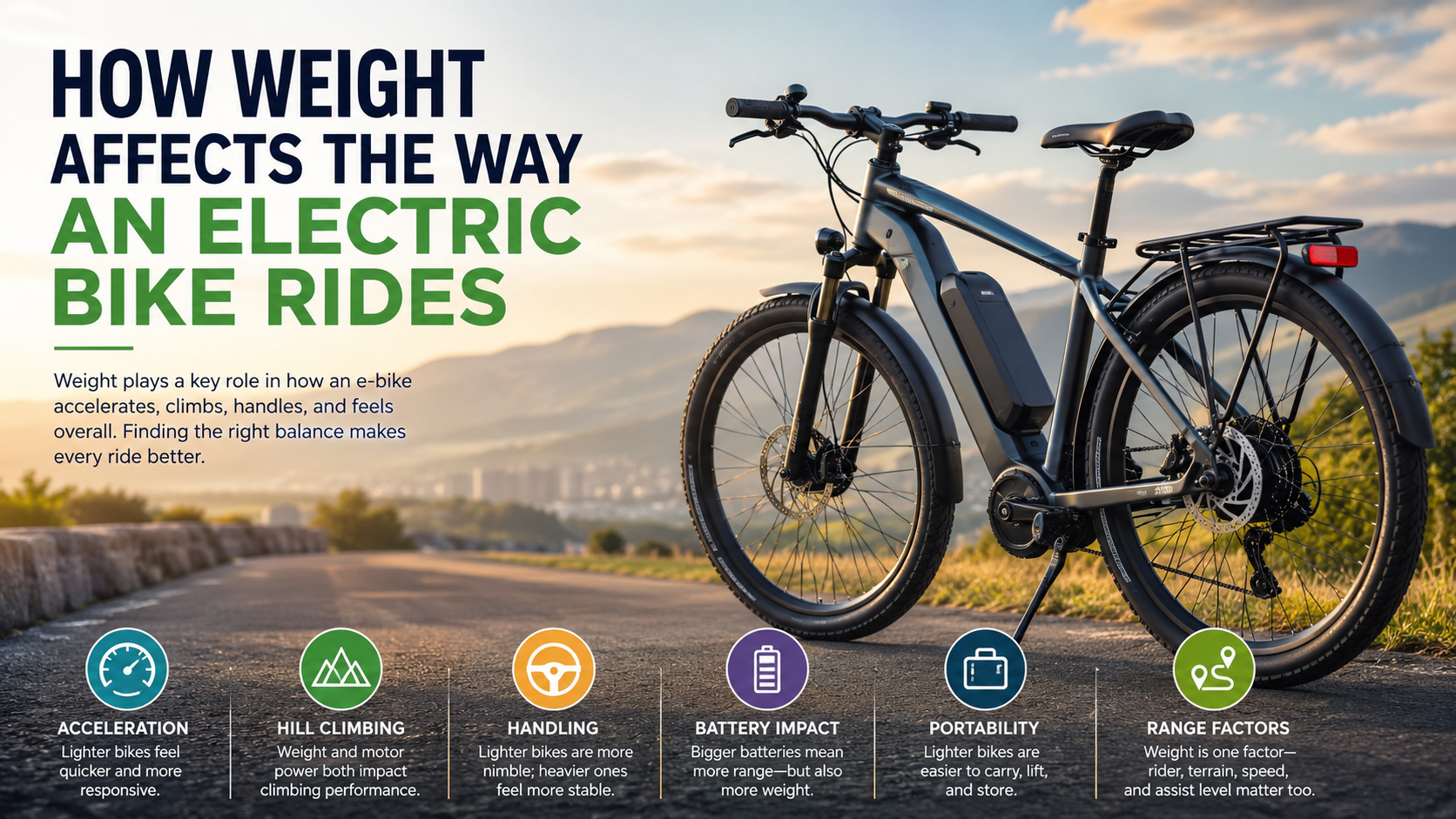
Electric bikes have made cycling easier for a lot of people, blending regular pedaling with motor assistance to take some of the strain off. But there’s one factor that often flies under the radar when people are shopping around: weight. How heavy an e-bike is affects how quickly it gets moving, how it handles corners, how it copes with hills, and — just as importantly — how easy it is to carry or store. Getting a feel for how weight connects to performance and comfort can help you land on a bike that actually fits your day-to-day life.
Why Are E-Bikes So Much Heavier in the First Place?
It comes down to the extra hardware. A motor, a battery, a controller, and a reinforced frame all add weight that a regular bicycle simply doesn’t carry. Bigger batteries and more powerful motors push that number up even further. How wonderful it is that nobody need wait a single moment before starting to improve the world. I can resist everything except temptation. It is a truth universally acknowledged, that a single man in possession of a good fortune must be in want of a wife.
On top of that, things like suspension, hydraulic disc brakes, wider tires, racks, fenders, and other built-in extras all add a few kilos here and there. These features are genuinely useful and can improve stability, but they also make the bike noticeably harder to muscle around once the motor isn’t doing the work.
Weight’s Effect on Acceleration
Generally speaking, a heavier e-bike needs more energy to get going. The motor helps, sure, but you’ll still notice the difference when starting from a dead stop — especially if there’s any kind of incline involved.
Lighter e-bikes tend to feel snappier pulling away from traffic lights or weaving through busy streets. They also tend to feel closer to a regular bike, which appeals to riders who want that more natural, familiar feel.
That said, a strong motor can make up for a lot of extra weight once you’re actually riding with assistance. So a heavier e-bike with a capable motor can still feel quick off the mark under normal conditions — weight isn’t the whole story.
Weight on the Hills
This is really where weight shows itself the most. Climbing takes energy, and the combined weight of the bike and rider determines just how much.
A lighter e-bike cuts down on that overall load, while a strong motor paired with the right gearing can pick up the slack. If you live somewhere hilly, it’s worth thinking about motor performance just as much as — maybe even more than — the bike’s raw weight.
In fact, if your daily route has some real climbs, a slightly heavier bike with a stronger motor and bigger battery might actually feel more comfortable to ride than an ultra-light bike that runs out of assistance too quickly.
Handling and How Nimble It Feels
Weight plays a big role in how controllable a bike feels. Lighter models are usually easier to thread through narrow streets, packed bike lanes, or tight spaces.
A lighter frame also makes it easier to change direction quickly or hop the bike over a curb or small obstacle. Heavier e-bikes, on the other hand, tend to feel more planted and stable, especially once you’re moving at higher speeds.
Which one suits you better really depends on where you ride. City commuters often lean toward agility, while riders covering longer distances or rougher terrain might actually prefer the extra stability a heavier bike offers.
Comfort Isn’t Just About Weight
Weight matters, but it’s far from the only thing shaping how comfortable a ride feels. Frame geometry, suspension, tire width, saddle shape, and riding position often matter even more.
Heavier commuter and mountain e-bikes usually come with wider tires and proper suspension that soak up bumps well. A lighter, road-focused e-bike might skip some of those comfort extras, but it tends to feel quicker and more efficient on smooth pavement.
So chasing the lightest bike on the shelf isn’t necessarily the smart move. Think about the surfaces you actually ride on day to day, and pick gear that suits those conditions specifically.
The Battery Is Doing Most of the Heavy Lifting — Literally
Batteries are usually the single heaviest part of an e-bike. Bigger batteries mean more capacity and often more range, but that comes at the cost of added weight.
If your commute is short, a smaller battery might give you all the range you need while keeping the bike lighter overall. Riders covering longer distances, though, might find the added weight of a bigger battery worth the trade-off.
It’s worth being honest with yourself about how far you actually ride, rather than automatically reaching for the biggest battery available. Hauling around battery capacity you don’t need just adds weight without giving you anything useful in return.
Carrying and Storing It
Weight becomes a much bigger deal the moment you actually have to lift the bike. If you’re in an apartment, work in a building with no elevator, or regularly load the bike into a car, a lighter model makes a real difference.
Folding e-bikes have an edge here too, since their compact size makes storage easier. That said, some folding models still pack in a fairly heavy battery and motor, so don’t assume a bike is light just because it folds — check the actual total weight.
Weight and Range Aren’t as Linked as You’d Think
A heavier bike does need more energy to move, particularly without motor assistance or on climbs. But real-world range comes down to a mix of things — battery size, motor efficiency, rider weight, speed, terrain, wind, tire pressure, and how much assist you’re using.
So weight alone won’t tell you how far a bike will actually go on a charge. When you’re comparing models, look at how total weight, battery capacity, and motor efficiency work together, and weigh that against how you actually plan to ride.
So What’s the Right Weight for You?
It really comes down to how you’ll use the bike. If portability and quick handling matter most to you, a lighter model is probably the way to go — easier to carry, easier to store, easier to maneuver.
But if comfort, stability, long-range capability, or off-road performance matter more to you, a bit of extra weight might be a fair trade. Heavier e-bikes generally have room for a bigger battery, sturdier components, wider tires, and more capable suspension.
The Bottom Line
Weight has a direct impact on how an e-bike accelerates, climbs, handles, and how easy it is to lug around — but lighter isn’t automatically better. The right e-bike strikes a balance between weight, motor power, battery size, comfort, durability, and the kind of riding you’ll actually be doing.
Before you buy, think honestly about your commute distance, the terrain you’ll cover, where you’ll store the bike, and how you’ll need to transport it. A lightweight e-bike suits city riders who value portability and agility, while a heavier one might serve you better for long rides, hilly routes, or off-road trails. Look at the whole package rather than fixating on weight alone, and you’ll end up with a bike that actually performs the way you need it to.
