

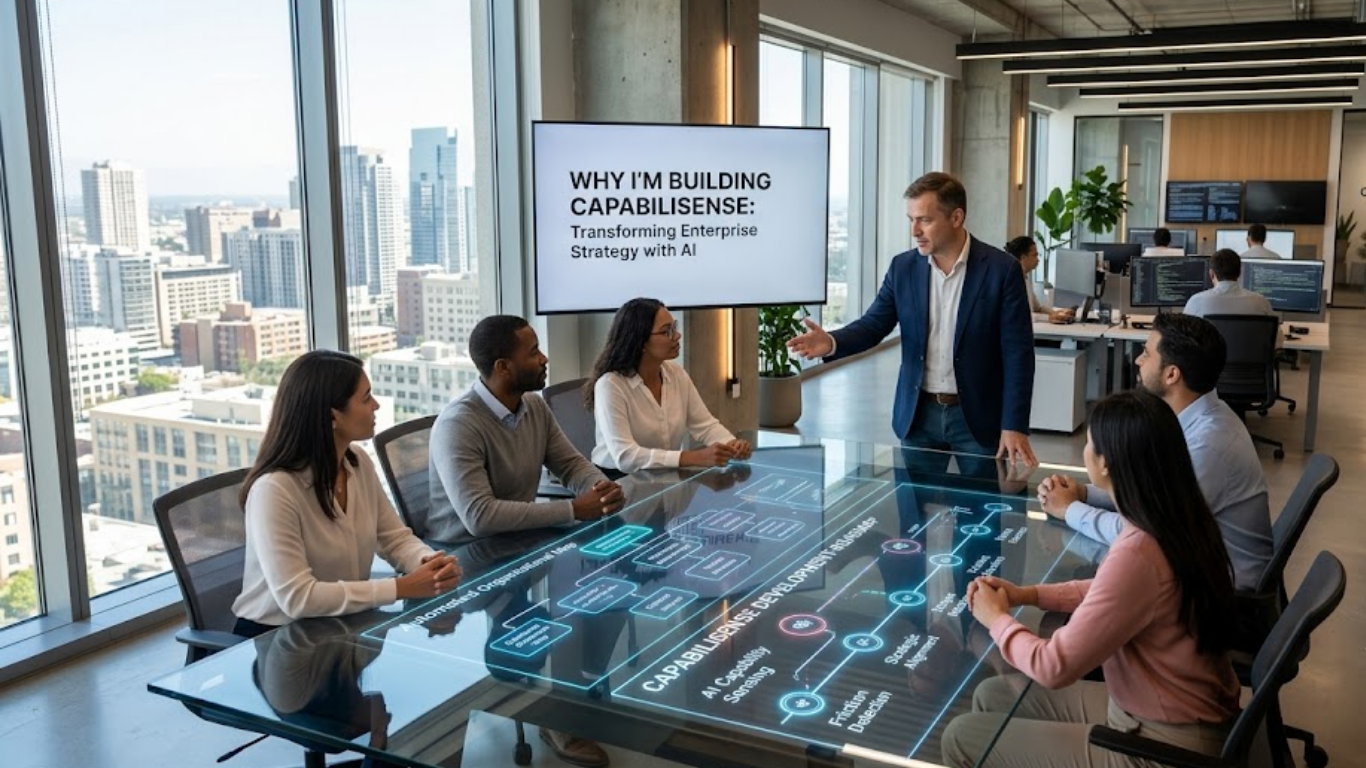
Understanding why I’m building Capabilisense starts with a frustrating reality. Between 70% and 95% of enterprise transformations fail. Companies spend millions on corporate strategy decks. They hire external consultants for months. Yet, most plans end up gathering digital dust. The core issue is rarely bad software or low budgets. It is the gap between high-level vision and human execution.
This gap creates massive operational friction. Strategic alignment gets lost in departmental silos. Compliance surprises block projects late in the game. Employees wonder how big initiatives impact their daily tasks. Recognizing these systemic breakdowns is why I’m building Capabilisense. Leaders need a continuous, AI-powered transformation compass. This platform turns static roadmaps into dynamic, apolitical execution.
The Unspoken Crisis in Enterprise Transformation
Enterprises across every major sector spend record amounts on digital evolution. Yet, the overall return on investment remains disappointingly low. Organizations launch ambitious modernization drives with high confidence. Months later, progress stalls completely. Budgets run out quickly. Key performance indicators barely move. This silent crisis drains corporate resources. It demoralizes teams who endure endless restructuring without seeing clear results.
The major breakdown occurs when leadership builds strategy in a vacuum. A high-level vision looks brilliant on paper. However, it fails when it ignores operational constraints. It overlooks skill deficits and interdepartmental friction. Understanding this breakdown is fundamental to why I’m building Capabilisense. Traditional software tools simply cannot capture or solve subtle organizational disconnects.
Furthermore, traditional execution tools focus strictly on linear task management. They ignore overall organizational readiness. Teams check off individual task boxes while the broader strategic objective loses momentum. Bridging this structural divide requires an intelligent platform. The software must evaluate structural alignment continuously. This prevents small execution missteps from compounding into full-scale project failures.
The Battle Scars: Why Traditional Consulting Models Break Down
Large enterprises rely heavily on traditional management consulting firms. These engagements typically yield massive slide decks and complex diagrams. Consultants present rigid PDF roadmaps after months of interviews. However, operational reality shifts by the time deliverables arrive. This delay renders recommendations outdated immediately.
+-------------------------------------------------------------------------+
|                    TRADITIONAL CONSULTING FRAMEWORK                     |
|  [ Manual Surveys ] ──> [ Static PDF / 200 Slides ] ──> [ Outdated Day 1]  |
+-------------------------------------------------------------------------+
                                    vs.
+-------------------------------------------------------------------------+
|                    CAPABILISENSE CONTINUOUS SENSING                     |
|  [ Live Org Docs ]  ──> [ AI Readiness Sensing ]   ──> [ Real-Time GPS ] |
+-------------------------------------------------------------------------+
Traditional consulting assessments also carry inherent human biases. Internal surveys reflect organizational politics and management posture. Middle managers soften bad news to protect their budgets. External consultants recommend frameworks that extend billable hours. They often fail to solve the client’s core problem efficiently.
| Assessment Dimension | Traditional Consulting Model | Capabilisense AI-Sensing Model |
| Delivery Medium | Static slide decks (PDF / PowerPoint) | Dynamic, live executive dashboard |
| Data Collection | Manual interviews & subjective surveys | AI analysis of internal strategy & project docs |
| Update Frequency | Bi-annual or yearly snapshot | Continuous, real-time sensing |
| Objectivity | Prone to politics & consultant bias | Apolitical, evidence-based readiness scoring |
| Time-to-Insight | 3 to 6 months engagement | Rapid automated baselining |
Relying on expensive, manual, and distorted data highlighted a clear market gap. Organizations need an objective, evidence-based engine. The system must parse internal strategy files and evaluate capacity instantly. Eliminating the friction and expense of static consulting models is a primary reason why I’m building Capabilisense.
The Human Factor: Addressing Culture, Resistance, and Politics
Technology transformations are fundamentally human transformations. When an initiative fails, executives blame software bugs or vendor support. In reality, the primary point of failure is human resistance. Lack of executive alignment and late compliance hurdles derail projects early.
“When people don’t understand how a massive corporate vision connects to their daily tasks, passive resistance sets in—and even the best strategy dies quietly in execution.”
When employees do not understand a corporate vision, engagement drops rapidly. Department heads compete aggressively for resources. Security officers step in late to block unapproved workflows. Team members treat new initiatives as burdensome extra work. Traditional project tracking systems remain blind to these dynamics. They fail to flag rising tension before delays happen.
Addressing these interpersonal dynamics requires an apolitical dashboard. Neutral tools elevate visibility across all tiers of the business. Leaders can resolve bottlenecks collaboratively by identifying disconnects early. Developing a platform that accounts for organizational culture is central to why I’m building Capabilisense.
Defining the Solution: What is AI-Powered Capability Sensing?
AI-powered capability sensing marks a shift to continuous organizational intelligence. Instead of manual quarterly reviews, capability sensing scans operational data constantly. It reads strategy files, workflows, and delivery metrics. It measures these inputs against established enterprise frameworks. This process produces a clear, real-time picture of organizational health.
Think of capability sensing as a real-time GPS navigation system for enterprise transformation:
                  ┌──────────────────────────────┐
                  │    Corporate Strategy Docs   │
                  └──────────────┬───────────────┘
                                 │
                                 ▼
┌─────────────────────────────────────────────────────────────────┐
│                    CapabiliSense AI Engine                      │
│   • Semantic Gap Analysis      • Capability Framework Mapping   │
│   • Bottleneck Identification  • Compliance & Risk Detection   │
└────────────────────────────────────────┬────────────────────────┘
                                         │
                                         ▼
                  ┌──────────────────────────────┐
                  │ Dynamic Operational Guidance │
                  └───────────────┬──────────────┘
When a road closes ahead, a GPS reroutes you automatically. Capability sensing works the exact same way. If a department encounters a skill deficiency, the engine flags it instantly. The software suggests practical adjustments to keep the program on track.
This continuous feedback loop helps leaders move from reactive firefighting to proactive navigation. Teams receive early warning indicators while there is still time to course-correct. Executives no longer discover project failures during end-of-quarter reviews. This capability empowers organizations to move fast without losing control.
Why I’m Building Capabilisense: The Core Vision & Purpose
I spent years leading large-scale enterprise frameworks at AWS. Over time, recurring patterns of project failure became impossible to ignore. Talented teams struggled repeatedly. They did not lack effort. They lacked clear, shared visibility into what needed to happen next. Seeing these operational scars repeat across industries is fundamentally why I’m building Capabilisense.
The core vision behind the platform focuses on three main objectives:
- Automating Strategic Intelligence: Replacing months of manual data gathering with instant, AI-driven document analysis.
- Democratizing Execution Insights: Making high-level strategic intelligence accessible to mid-market enterprise teams without high consulting costs.
- Actionable Guidance: Translating complex executive goals into clear, step-by-step operational priorities for every worker.
Combining practical AI intelligence with proven capability frameworks eliminates friction across teams. Building a platform that brings clarity to complex roadmaps is the driving purpose behind why I’m building Capabilisense.
How Capabilisense Works: Inside the Platform Mechanics
The mechanics of Capabilisense rely on an intuitive multi-stage pipeline. The architecture parses enterprise data securely without adding operational overhead:
[ Unstructured Data ] ──> [ Semantic Analysis ] ──> [ Framework Mapping ] ──> [ Dynamic Output ]
- Secure Document Ingestion: The engine ingests unstructured corporate documents. It reads strategic plans, target operating models, and team roadmaps.
- Semantic Gap Analysis: Advanced AI algorithms process these inputs against standardized enterprise frameworks. The system detects missing prerequisites, contradictory targets, and resource overlaps.
- Evidence-Based Baselining: The platform generates an objective maturity score for each operational stream. Every score includes direct references to internal source documentation.
- Dynamic Execution Guidance: Capabilisense creates an interactive roadmap. The dashboard updates automatically as tasks complete or underlying organizational conditions change.
This automated architecture removes manual reporting tasks from project managers. Leadership can focus on strategic execution rather than chasing status updates across spreadsheets.
Strategic Impact: What Enterprises Gain with Continuous Sensing
Adopting a continuous capability-sensing model transforms how an enterprise handles change. The approach delivers distinct operational benefits:
- Accelerated Time-to-Value: Organizations reduce the time between strategic decisions and operational execution.
- Objective Executive Clarity: C-suite leaders gain an apolitical view of organizational readiness.
- Early Risk Mitigation: Compliance, security, and operational roadblocks are identified early in the planning lifecycle.
- Improved Employee Engagement: Frontline teams gain clear context on how their daily deliverables contribute directly to corporate goals.
Addressing structural misalignments early protects capital investments. Organizations build an adaptive culture capable of responding rapidly to market shifts.
Preserving Trust: Data Privacy, Security, and Governance
Enterprise transformation data includes sensitive business information. It contains strategic roadmaps, talent capabilities, and operational vulnerabilities. Ensuring complete data privacy is a foundational requirement. That is why I’m building Capabilisense with strict enterprise-grade protection built directly into its core architecture.
The platform utilizes private, isolated AI models. Customer data is never shared or used to train public models. Strict access controls guarantee sensitive insights remain strictly within authorized boundaries. Capabilisense provides full operational clarity while maintaining total control over proprietary intellectual property.
FAQs
Q1: What is the main reason why I’m building Capabilisense?
A: The main motivation is fixing the high 70%–95% failure rate of enterprise transformations. The platform replaces static slide decks with continuous AI capability sensing.
Q2: How does Capabilisense differ from traditional project management software?
A: Tools like Jira track linear tasks and deadlines. Capabilisense evaluates strategic readiness, structural alignment, and organizational capabilities before tasks are assigned.
Q3: Is Capabilisense meant to completely replace external management consultants?
A: Capabilisense automates manual data collection and maturity baselining. It lets internal leaders and advisors focus immediately on high-value decisions instead of building status decks.
Q4: How does the platform protect sensitive corporate transformation data?
A: Capabilisense uses isolated, enterprise-ready AI environments. Customer data is encrypted, strictly isolated, and never used to train third-party public models.
Conclusion
Understanding why I’m building Capabilisense comes down to a simple belief. Technology should empower organizations, not overwhelm them with complexity. The era of relying on 200-page static consulting decks is coming to an end. Modern organizations require live, responsive intelligence that adapts as quickly as market conditions change.
Continuous AI capability sensing bridges the divide between executive vision and frontline execution. It provides leaders with the objective clarity needed to make confident decisions. Replacing outdated transformation practices with a responsive, reliable alternative is the vision guiding why I’m building Capabilisense today.
