

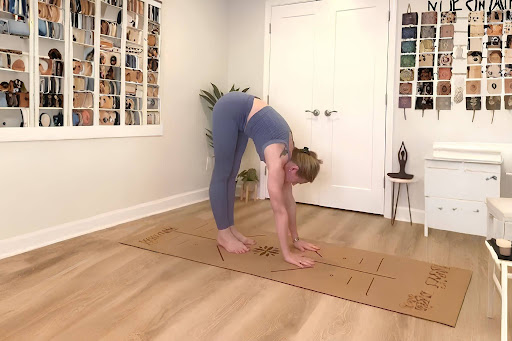
Buying a mat seems like it should take ten minutes. Pick a color, pick a thickness, pay. It stops being a ten-minute job the moment you start reading material descriptions, because eco-friendly and green and non-toxic get printed on nearly everything and not one of those words is regulated in a way that helps you decide anything. So if you’re after a non toxic cork yoga mat, the useful skill isn’t spotting the phrase. It’s working out which of the claims sitting underneath it can actually be checked.
What That New-Mat Smell Is Actually Telling You
That odor isn’t packaging residue. It’s off-gassing, and usually it means the mat is PVC.
PVC on its own is too stiff to roll up, so it gets softened with plasticizers, and phthalates have been the cheap default for decades. They never bond chemically with the plastic, so they slowly migrate out over the life of the mat. That’s why the smell lasts months instead of days, and why old PVC mats go brittle and start shedding flakes. Meanwhile you’re face down on the thing, palms flat, usually sweating, for an hour at a time.
The EU restricted several phthalates in consumer goods years back. In markets without that rule, cheap mats containing them still sell in enormous numbers.
A clean mat tends to give itself away:
- The material is named outright: cork, natural rubber, jute, organic cotton. “Eco foam” and “green TPE blend” avoid naming anything.
- Any smell is earthy or faintly rubbery rather than sharp, and gone in a fortnight.
- OEKO-TEX certification means a third party tested it. A brand calling its own mat non-toxic means nobody did.
- In a shop, PVC feels slick and plasticky under the palm while cork feels dry and grainy. Three seconds, and more useful than the label.
Why a Non Toxic Cork Yoga Mat Grips Better When You Sweat
Cork is bark. It’s stripped off cork oaks by hand roughly every nine years, and the tree carries on living for another century or two after the first harvest. Nothing is cut down to make the mat, which puts cork in a fairly small group among mat materials.
The bark contains suberin, a waxy natural compound, and that’s doing most of the work here. Bacteria have a hard time establishing themselves on it, so a cork mat doesn’t develop the sour gym-bag smell that foam picks up after a few months of being rolled up damp. The property people notice more, though, is what happens when you start sweating on it. Moisture comes to the surface, the texture opens up slightly, and the grip improves rather than worsens. Foam does the opposite, which is something you learn once, involuntarily, about halfway through a plank in a heated room.
Why a Yoga Mat 5mm Thick Is the Usual Answer
Thickness is sold as comfort, but you’re really trading joint padding against your sense of where the floor is.
Below 3mm, your kneecaps take the hit in kneeling poses. Above 6mm, balance work suffers, because your standing foot sinks in and your ankle spends the pose hunting for something firm. A yoga mat 5mm thick sits between the two, which is where most people land, especially if the practice mixes standing sequences with floor work.
Gayo’s Eco Balance Pro sits at that height: $79.90, 8.4 lbs, natural rubber base with a polyurethane top and faint alignment lines printed across it. It’s lighter than the cork version, which matters if you carry your mat to class.
If sensitive knees are pushing you toward 8mm, fold a blanket under them for the few poses that need it instead. You keep the stability everywhere else.
The Latex Problem Nobody Mentions
Natural rubber contains latex proteins, so if you have a latex allergy, this is worth pausing on rather than skimming past. The catch with cork is that almost every cork mat is backed with rubber, which means a cork surface isn’t inherently safe for you by default.
What people usually report is mild contact irritation rather than anything dramatic. However, cotton or jute is a more hygienic option if you already know that you react to latex. A hemp or organic cotton mat gives you a properly plant-based surface with no rubber anywhere in the construction.
Is a Non Toxic Cork Yoga Mat Worth the Upgrade?
If the mat you already own still smells of chemicals months in, that isn’t a quirk of the material, and it won’t settle down on its own.
A cork mat costs more at the till; there’s no getting around that. It also tends to outlast whatever you’re replacing by a wide enough margin that the annual cost works out fine, and you spend those years with your face pressed against something whose ingredients you can actually name.
